


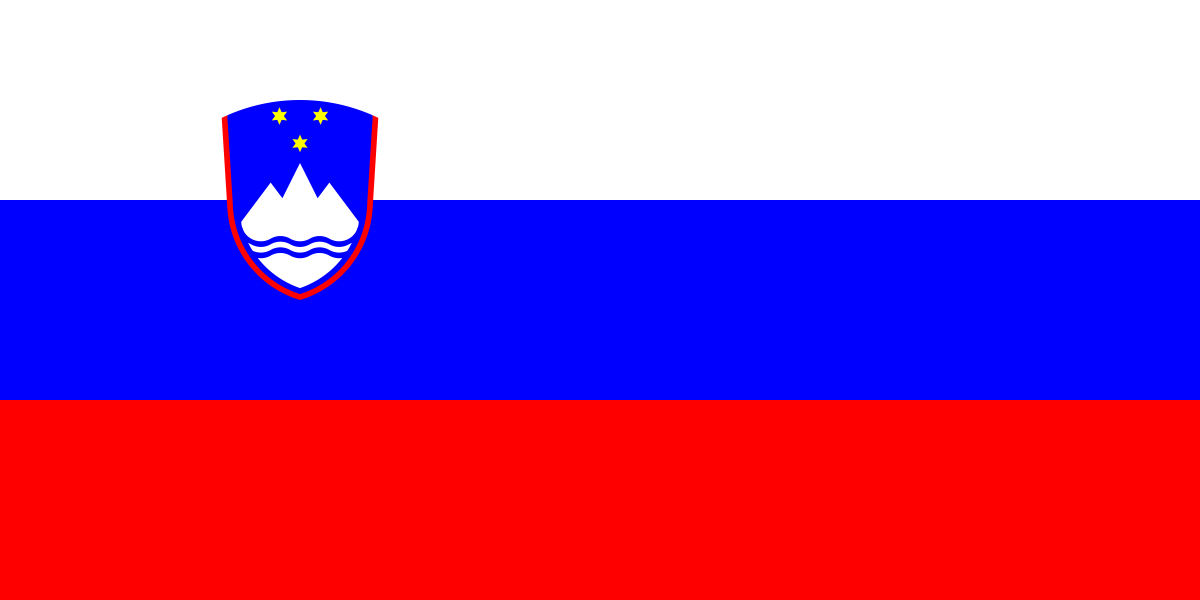
Slovenia rarely makes the shortlist when companies look for European hosting. Frankfurt, Amsterdam, Dublin, and London dominate the conversation. That's a missed opportunity. For specific workloads, particularly those targeting Central and Eastern Europe or requiring strong EU data residency, a Slovenian provider can be the better technical and commercial choice.
This guide explains when Slovenia makes sense, what to verify before signing up, and how the local market compares to bigger EU hubs.
When Slovenia is the right choice
Consider Slovenian hosting when one or more of these apply:
- You serve customers in Central and Eastern Europe. Latency from Ljubljana to Zagreb, Budapest, Vienna, Belgrade, and Bucharest is significantly lower than from Frankfurt or Amsterdam. For latency-sensitive applications, this matters.
- You need genuine EU data sovereignty. Slovenia is a full EU member with no special arrangements that complicate data residency claims. There's no equivalent of the Irish or Luxembourgish tax-driven hosting industry that creates ambiguity about US parent company access.
- GDPR with native EU operation. A provider based in the EU, owned by EU nationals, with no US subsidiary or parent company simplifies your Data Processing Agreement and sub-processor disclosures.
- You want hands-on support without enterprise sales overhead. Smaller Slovenian providers typically respond in minutes, not business days, and you talk to engineers who know your setup.
- You're consolidating regional infrastructure. One provider for VPS, dedicated servers, object storage, and domains, with one invoice and one contract.
If you only need cheap commodity VPS at the lowest possible price, the volume providers in Germany or France will be cheaper. Slovenia competes on different axes.
Technical landscape
Modern Slovenian hosting providers run on the same infrastructure stack as their larger European counterparts: Proxmox or VMware virtualization, Ceph or enterprise SAN storage, 25 or 40 GbE clusters, BGP multi-homing through Slovenian and EU transit providers.
Connectivity to the rest of Europe is excellent. The Slovenian Internet eXchange (SiX) peers with regional ISPs, and Slovenia has direct fiber routes through Austria to the major European exchange points. Round-trip latency from Ljubljana to Frankfurt is around 15 ms, to Vienna under 10 ms, to Milan around 12 ms.
For workloads targeting CEE customers specifically, a server in Slovenia can outperform one in Frankfurt because the latency advantage to Zagreb, Belgrade, Budapest, and Sarajevo is substantial.
Regulatory and commercial environment
Slovenia is a EUR-zone EU member, so for B2B customers within the EU, standard reverse-charge VAT rules apply (Article 196 of Directive 2006/112/EC). Slovenian providers issue invoices in EUR, can issue documents in English on request, and are subject to standard EU consumer and commercial law.
For Slovenian and other CEE customers, local invoicing in local currency and language is a significant advantage. For non-EU customers (UK, US, Switzerland), Slovenian providers typically handle invoicing in EUR with no VAT charged when the customer provides valid business documentation.
There's no equivalent in Slovenia of the US CLOUD Act, since Slovenian companies have no obligation to disclose data to non-EU authorities outside of mutual legal assistance treaties. This matters for some compliance regimes.
What to verify before signing up
Not every "Slovenian" provider is what it appears. Verify these specifically:
Where data is actually stored. Some providers brand as Slovenian but rent rack space in Germany or the Netherlands. Ask for the specific datacenter address and physical location of your VPS or dedicated server.
Company structure. A d.o.o. (limited liability company) is more stable than a sole proprietorship (s.p.). Check the company registration through the Slovenian business register (AJPES) for free.
Infrastructure specifics. Ask about storage redundancy (Ceph replication, RAID configuration, snapshot frequency), network topology (single uplink vs BGP multi-homed), and disaster recovery plans.
SLA or SLO? Many providers blur the line. An SLA is a contractual commitment with defined credits for breaches. An SLO is a transparent target the provider commits to measure and report against. Ask which you're getting and how it's measured. At MMITech we operate on a clearly documented 99.9% SLO for availability rather than vague marketing claims.
Backup approach. Are backups included or extra? Where are they stored? How often? What's the retention period? Can you restore individual files or only full snapshots?
Support availability. Which channels (ticket, phone, chat)? In which languages? What hours? Same engineer or rotating shifts?
Migration support. Will they help you move in from your current provider, or are you on your own?
How Slovenia compares to other EU hosting markets
vs Germany (Hetzner, IONOS, Contabo): German providers win on raw price and scale. Slovenia wins on support responsiveness, no automated account suspension on shared subnets, and better CEE latency.
vs Netherlands (Leaseweb, TransIP): Comparable infrastructure quality. Slovenia is closer to CEE customers and typically cheaper for equivalent specs.
vs France (OVH, Scaleway): OVH offers more locations and managed services. Slovenia offers more personal support and clearer pricing without the upsell ladder.
vs Ireland (AWS, Azure regions): Different category entirely. Hyperscalers offer breadth of services Slovenian providers don't replicate. Slovenia competes on simple infrastructure with human support, not on managed Kubernetes or AI APIs.
Common misconceptions
"Slovenia is too small to have serious infrastructure." Modern Slovenian providers operate enterprise-grade Ceph clusters, 40 GbE networking, and BGP multi-homing. The infrastructure isn't smaller than what you'd rent at a comparable price elsewhere.
"Local providers can't scale." Slovenian providers typically scale customers from single VPS to multi-server private cloud or dedicated cluster setups within the same relationship.
"Support quality is lower." The opposite is usually true for small to medium customers. You get faster responses from engineers who remember your account, not first-tier scripted support.
What MMITech offers
We're a Slovenian d.o.o. based in Kranj, operating since 2017, with our own infrastructure in Slovenia, ASN 213115, and a customer base across seven European language markets. Our services:
- Cloud VPS and AMD VPS plans, hourly or monthly billing
- Dedicated servers for high-performance workloads
- Nextcloud storage for companies needing a private file platform
- Domain registration and web hosting
- Support in English, Slovenian, German, Italian, Croatian, Czech, and Hungarian
- Real engineers responding to tickets, not chatbots or first-tier scripts
If you're considering Slovenia for your next deployment, contact us and we'll help you evaluate whether it's the right fit. No sales tactics, just an honest assessment of your workload and what we can do.